Consider all the tax consequences before making gifts to loved ones

Many people choose to pass assets to the next generation during life, whether to reduce the size of their taxable estate, to help out family members or simply to see their loved ones enjoy the gifts. If you’re considering lifetime gifts, be aware that which assets you give can produce substantially different tax consequences.
Multiple types of taxes
Federal gift and estate taxes generally apply at a rate of 40% to transfers in excess of your available gift and estate tax exemption. Under the Tax Cuts and Jobs Act, the exemption has approximately doubled through 2025. For 2018, it’s $11.18 million (twice that for married couples with proper estate planning strategies in place).
Even if your estate isn’t large enough for gift and estate taxes to currently be a concern, there are income tax consequences to consider. Plus, the gift and estate tax exemption is scheduled to drop back to an inflation-adjusted $5 million in 2026.
Minimizing estate tax
If your estate is large enough that estate tax is a concern, consider gifting property with the greatest future appreciation potential. You’ll remove that future appreciation from your taxable estate.
If estate tax isn’t a concern, your family may be better off tax-wise if you hold on to the property and let it appreciate in your hands. At your death, the property’s value for income tax purposes will be “stepped up” to fair market value. This means that, if your heirs sell the property, they won’t have to pay any income tax on the appreciation that occurred during your life.
Even if estate tax is a concern, you should compare the potential estate tax savings from gifting the property now to the potential income tax savings for your heirs if you hold on to the property.
Minimizing your beneficiary’s income tax
You can save income tax for your heirs by gifting property that hasn’t appreciated significantly while you’ve owned it. The beneficiary can sell the property at a minimal income tax cost.
On the other hand, hold on to property that has already appreciated significantly so that your heirs can enjoy the step-up in basis at your death. If they sell the property shortly after your death, before it’s had time to appreciate much more, they’ll owe no or minimal income tax on the sale.
Minimizing your own income tax
Don’t gift property that’s declined in value. A better option is generally to sell the property so you can take the tax loss. You can then gift the sale proceeds.
Capital losses can offset capital gains, and up to $3,000 of losses can offset other types of income, such as from salary, bonuses or retirement plan distributions. Excess losses can be carried forward until death.
Choose gifts wisely
No matter your current net worth, it’s important to choose gifts wisely. Please contact us to discuss the gift, estate and income tax consequences of any gifts you’d like to make.
© 2018

 In today’s tightening job market, to attract and retain the best employees, small businesses need to offer not only competitive pay, but also appealing fringe benefits. Benefits that are tax-free are especially attractive to employees. Let’s take a quick look at some popular options.
 It’s easy to understand why more and more businesses are taking a “bring your own device” (BYOD) approach to the smartphones, tablets and laptops many employees rely on to do their jobs. BYOD can boost employee efficiency and satisfaction, often while reducing a company’s IT costs. But the approach isn’t without risk for both you and your staff. So, it’s highly advisable to create a strong formal policy that combines convenience with security.
 If you’re age 70½ or older, you can make direct contributions — up to $100,000 annually — from your IRA to qualified charitable organizations without owing any income tax on the distributions. This break may be especially beneficial now because of Tax Cuts and Jobs Act (TCJA) changes that affect who can benefit from the itemized deduction for charitable donations.
 Like many business owners, you probably created a business plan when you launched your company. But, as is also often the case, you may not have looked at it much since then. Now that fall has arrived and year end is coming soon, why not dig it out? Reviewing and revising a business plan can be a great way to plan for the year ahead.
 For investors, fall is a good time to review year-to-date gains and losses. Not only can it help you assess your financial health, but it also can help you determine whether to buy or sell investments before year end to save taxes. This year, you also need to keep in mind the impact of the Tax Cuts and Jobs Act (TCJA). While the TCJA didn’t change long-term capital gains rates, it did change the tax brackets for long-term capital gains and qualified dividends.
 If you’re charitably inclined and you collect art, appreciated artwork can make one of the best charitable gifts from a tax perspective. In general, donating appreciated property is doubly beneficial because you can both enjoy a valuable tax deduction and avoid the capital gains taxes you’d owe if you sold the property. The extra benefit from donating
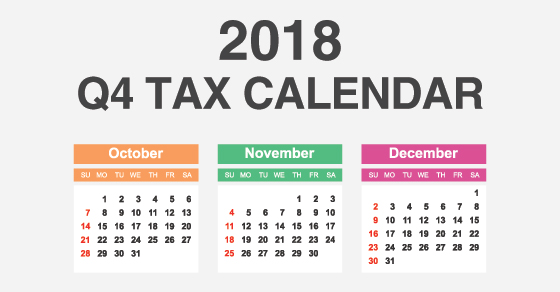 Here are some of the key tax-related deadlines affecting businesses and other employers during the fourth quarter of 2018. Keep in mind that this list isn’t all-inclusive, so there may be additional deadlines that apply to you. Contact us to ensure you’re meeting all applicable deadlines and to learn more about the filing requirements.
 Every business with more than one owner needs a buy-sell agreement to handle both expected and unexpected ownership changes. When creating or updating yours, be sure you’re prepared for the valuation issues that will come into play.
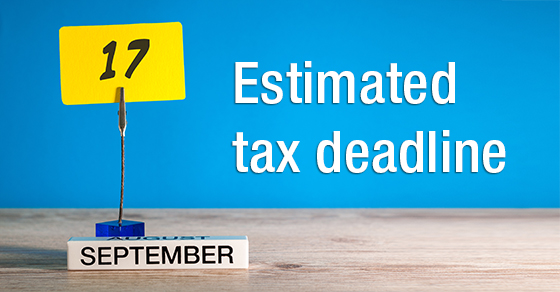 To avoid interest and penalties, you must make sufficient federal income tax payments long before your April filing deadline through withholding, estimated tax payments, or a combination of the two. The third 2018 estimated tax payment deadline for individuals is September 17.