Do you need to make an estimated tax payment by September 17?
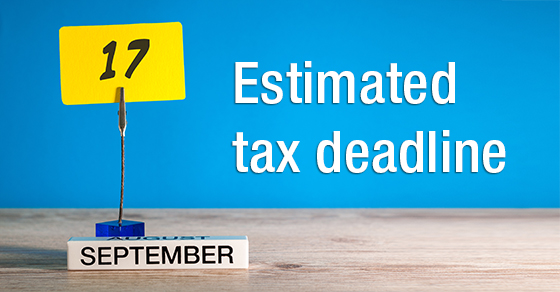 To avoid interest and penalties, you must make sufficient federal income tax payments long before your April filing deadline through withholding, estimated tax payments, or a combination of the two. The third 2018 estimated tax payment deadline for individuals is September 17.
If you don’t have an employer withholding tax from your pay, you likely need to make estimated tax payments. But even if you do have withholding, you might need to pay estimated tax. It can be necessary if you have more than a nominal amount of income from sources such as self-employment, interest, dividends, alimony, rent, prizes, awards or the sales of assets.
A two-prong test
Generally, you must pay estimated tax for 2018 if both of these statements apply:
- You expect to owe at least $1,000 in tax after subtracting tax withholding and credits, and
- You expect withholding and credits to be less than the smaller of 90% of your tax for 2018 or 100% of the tax on your 2017 return — 110% if your 2017 adjusted gross income was more than $150,000 ($75,000 for married couples filing separately).
If you’re a sole proprietor, partner or S corporation shareholder, you generally have to make estimated tax payments if you expect to owe $1,000 or more in tax when you file your return.
Quarterly payments
Estimated tax payments are spaced through the year into four periods or due dates. Generally, the due dates are April 15, June 15 and September 15 of the tax year and January 15 of the next year, unless the date falls on a weekend or holiday (hence the September 17 deadline this year).
Estimated tax is calculated by factoring in expected gross income, taxable income, deductions and credits for the year. The easiest way to pay estimated tax is electronically through the Electronic Federal Tax Payment System. You can also pay estimated tax by check or money order using the Estimated Tax Payment Voucher or by credit or debit card.
Confirming withholding
If you determine you don’t need to make estimated tax payments for 2018, it’s a good idea to confirm that the appropriate amount is being withheld from your paycheck. To reflect changes under the Tax Cuts and Jobs Act (TCJA), the IRS updated the tables that indicate how much employers should withhold from their employees’ pay, generally reducing the amount withheld.
The new tables might cause some taxpayers to not have enough withheld to pay their ultimate tax liabilities under the TCJA. The IRS has updated its withholding calculator (available at irs.gov) to assist taxpayers in reviewing their situations.
Avoiding penalties
Keep in mind that, if you underpaid estimated taxes in earlier quarters, you generally can’t avoid penalties by making larger estimated payments in later quarters. But if you also have withholding, you may be able to avoid penalties by having the estimated tax shortfall withheld.
To learn more about estimated tax and withholding — and for help determining how much tax you should be paying during the year — contact us.
© 2018

 If you gamble, be sure you understand the tax consequences. Both wins and losses can affect your income tax bill. And changes under the Tax Cuts and Jobs Act (TCJA) could also have an impact.
 IT consultants are many things — experts in their field, champions of the workaround and, generally, the “people persons” of the tech field. But they’re not magicians who, with the wave of a smartphone, can solve any dilemma you throw at them. Here are six ways to get more value from your company’s next IT consulting relationship:
 The Tax Cuts and Jobs Act (TCJA) liberalized the eligibility rules for using the cash method of accounting, making this method — which is simpler than the accrual method — available to more businesses. Now the IRS has provided procedures a small business taxpayer can use to obtain automatic consent to change its method of accounting under the TCJA. If you have the option to use either accounting method, it pays to consider whether switching methods would be beneficial.
 As a business grows, one of many challenges it faces is identifying a competitive yet manageable compensation structure. After all, offer too little and you likely won’t have much success in hiring. Offer too much and you may compromise cash flow and profitability.
 Converting a traditional IRA to a Roth IRA can provide tax-free growth and tax-free withdrawals in retirement. But what if you convert your traditional IRA — subject to income taxes on all earnings and deductible contributions — and then discover you would have been better off if you hadn’t converted it?
 In an increasingly global economy, keeping a close eye on your supply chain is imperative. Even if your company operates only locally or nationally, your suppliers could be affected by wider economic conditions and developments. So, make sure you’re regularly assessing where weak links in your supply chain may lie.
 There was talk of repealing the individual alternative minimum tax (AMT) as part of last year’s tax reform legislation. A repeal wasn’t included in the final version of the Tax Cuts and Jobs Act (TCJA), but the TCJA will reduce the number of taxpayers subject to the AMT.
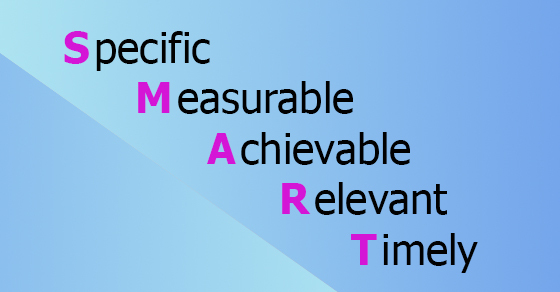 Strategic planning is key to ensuring every company’s long-term viability, and goal setting is an indispensable step toward fulfilling those plans. Unfortunately, businesses often don’t accomplish their overall strategic plans because they’re unable to fully reach the various goals necessary to get there.
 When business use of websites began, getting noticed was the name of the game. Remember pop-up ads? Text scrolling up the screen? How about those mesmerizing rotating banners? Yes, there were — and remain — a variety of comical and some would say annoying ways to get visitors’ attention.